Friday, 30 July 2010

Film Review: TTS: Eclipse

Following on from the spectacular non-event that was New Moon – which, as far as I can remember, just featured Kristen Stewert sobbing in the corner for a couple of hours while Taylor Lautner injected his biceps with minced beef crying “Do you love me now” – the latest instalment in the bafflingly popular Twilight series, Eclipse, reared its chiselled, sparkling and forever sulking head in cinemas a few weeks ago, and with me having this weird, almost masochistic urge to toddle along and sit through two hours of this emotionally undead (geddit?) garbage every time it comes out, I just had to get in on the fun.

It’s some time after the “surprise” proposal ending of New Moon – at least I’m assuming it was a surprise ending because of the way the girls sitting in front of me gasped, but it’s just as possible they’d spent the film building up to a climax and the close up of Robert Pattinson tipped them over the edge – and everything is pretty much where we left it. Bella and Edward aren’t married, since Bella won’t marry a vampire (common sense prevails?) until he turns her into a vampire (maybe not then), but that hasn’t stopped Edward popping the question over and over again, although fortunately he stops just short of a full-on Mrs Doyle impersonation. Jacob is still hanging around too, probably shirtless, and is still a bit miffed about whatever happened in the last film. So the whole love story thing hasn’t gotten any more interesting than it already wasn’t, but at least now there’s a decent sub-plot with some real vampires kicking off down the road.

One of the underdeveloped “proper” vampires Victoria (the ginger one from the first film), and she’s got a bit of a grudge against Bella; their respective vampire boyfriends had a bit of a scrap and Victoria’s ended up a bit dead. So, after spending the last film plotting somewhere, she’s now building an army of unborn vampires to help get her revenge. Which almost sounds cool, but as it turns out there are six children in the army and they’re led by someone called Riley who looks like he fell out of a failed boy band. Still, as non-threatening as the army is, they do help drive Eclipse forward at a decent pace, something that New Moon totally lacked.

With the vampiric Mickey Mouse Club fast approaching, the Forks vampire and werewolf clans are forced to come together to protect Bella. Given the long, bloody history between them you’d be forgiven for expecting a tense couple of scenes, but everything is a bit unintentionally hilarious. The Cullen clan are quite camp at the best of times, so when one of them starts strutting around in front of the bemused looking werewolves pretending to be a drill instructor it’s a little difficult to keep a straight face. On the plus side the resulting action sequences aren’t half bad; they are a bit too much like those ridiculously homo-erotic Olympic events where men is testes-smothering leotards flip around on a mat, but there’s a surprisingly satisfying amount of neck snapping going on. So there’s half a thumbs-up for that.

Probably the most interesting part of Eclipse, though, doesn’t really have anything to do with the actual plot, or either of the other films’ plots for that matter. Until now the focus has very much been on Bella, Edward and occasionally Jacob, none of whom are particularly deep, complicated or even interesting characters, so it’s a refreshing change when some of the minor characters grasp the limelight for a couple of minutes and reveal their much darker pasts. There’s not always much relevance in it – one of Edwards sisters barely has a line for most of the film but still gets a few minutes of flashbacks detailing how she killed some guy once – but it gives some of the characters a depth that so far the series has been without.

It’s a shame, then, that these characters are inevitably pushed to the side when Bella swans (ba dum) her way onto the screen with Edward and Jacob in tow. In fairness they do seem to have developed a little more personality since the last romantic tug-of-war and even go as far as to force a smile and crack a joke every now and then, but for the most part they’re still painfully dull characters, which is only emphasised by Stewert, Pattinson and Lautner’s perpetually uninterested performances. But I guess it’s not all bad; Taylor clearly hasn’t let up on the fitness regime in-between filming. You’d have to be as flaccid as boiled celery not to feel a little twinge in your drawers when you look at him, from the neck down at least.

All things considered Eclipse, while still lumped with the same flaws of the previous films, is still the high point of the series so far. The action scenes are rather stylish, there’s a willing self-mocking that I’ve carefully avoided mentioning because it’s not possible to poke fun at, and the pacing is, er, existent. Whether it actually qualifies as a half decent film is still debatable; unless you’re a thirteen year old girl in that weird transitional phase where you’ve started playing horsey on the arm of the living room sofa. Then it’s awesome.

2/5: The best instalment so far, but the series’ flaws show no signs of fading. There’s a glimmer of promise in the Twilight universe, but so long as it’s overshadowed by the eternally predictable romantic mush that’s all it will ever be.

Can someone buy the flabby members of the Wolf Pack shirts of the next film? Or at very least give them some Creatine. Their appearance next to Taylor makes me feel genuinely sad for them.

Sunday, 30 May 2010

Film Review: Prince of Persia: The Sands of Time

Over the summer we often have a couple of games based on cinema’s mega blockbusters, and more often than not these turn out... well... not particularly well. Nine times out of ten they’re lame cash-ins by unsuccessful branches of big developers who are trying to prove they’re still worth something. Now Prince of Persia: The Sands of Time (loosely based on the 2003 video game) has gone the other way and has - despite having a decent director, producer and cast - turned out in a similarly lame way.

The Prince of Persia in question is a weirdly British street urchin who is adopted by the king of Persia for throwing an apple at a guards head and running away. Fast forward some twenty years and he’s become the weirdly British Prince Dastan (Jake Gyllenhaal) who, during a not-really-epic battle in the sacred city of Alamut, comes across the Dagger of Time. Various events unfold – the big one being that Dastan is framed for his father’s murder – and he ends up on the run with the Princess of Alamut, Tamina (Gemma Arteton), where he accidentally triggers the dagger’s magical, time-reversing power. A few more things happen (there’s an unnecessary trip to the ostrich races and a funny (annoying) man in a turban complains about taxes) and, after the bad guy is “revealed” as Dastan’s nefarious-looking Uncle Nizam (Ben Kingsley), he decides to help Tamina take the dagger back to where it belongs; although not without some more unnecessary stuff padding out the story in-between.

It’s this superfluous padding out that brings Prince of Persia down; the core story is simple enough, as a summer blockbuster should be, but too many sub-plots and minor characters are brought in and they just get in the way. Because of this the relationship between the leads, Dastan and Tamina, never gets properly fleshed out, and Dastan’s relationship with his brothers is barely even touched on. Really, the only relationship that seems to have any depth is the one between the man in a turban and someone who follows him around throwing knives; and chances are you won’t remember their names ten minutes after the film has ended.

Still, maybe that’s a bit of a blessing in disguise, because what little we do see of the Prince beyond his running, jumping, flipping and sword-swinging talents suggests that he ticks every irritating Disney-hero box possible without bursting into song every fifteen minutes. Almost every utterance is dripping with cringe-worthy smarm. Even when one of the characters dies and he’s confronted by someone grieving their loss by asking him if they’d told him the recently deceased’s story, he bluntly replies “Yes, you have” and walks away. He’s utterly unlikable and Gyllenhaaal’s lazy performance, which is essentially him strutting and smirking in-between dispensing his smug one-liners (complete with a grating British accent throughout), doesn’t help matters.

Although it’s probably unfair to merely highlight Gyllenhaaaal’s character and performance because, in truth, very few of the characters stand out. Arteton occasionally tries with Tamina and sometimes there is a genuine spunk about her, but this is inconsistent with the typical damsel-in-distress role she usually ends up playing when some big nasty men show up. She looks quite nice, though. Dastan’s princely brothers have an annoying habit of swapping sides every half an hour without any obvious reason and they’re performed with the same dodgy accents that Gyllenhaaaaal adopted, and Ben Kingsley’s Nizam just seems a little bored. The only character that actually seems to be enjoying himself is Alfred Molina’s Sheik Amar (the aforementioned man in a turban), and so most of the films humour does end up coming from him – although for the most part it’s a slightly weird, perhaps more adult humour (there’s a strong suggestion that he has sex with an ostrich) that will go over the head of most of the 12A/PG-13 audience.

Since the humour is maybe a little misjudged and none of the characters are particularly fun or likable, Prince of Persia’s action had to compensate – which it does, if only a little. The few free-running sequences are suitably slick and stylishly filmed (there’s a rather smart, video-game inspired angle to some of the shots that should press the right buttons with the game’s fans) and the fight sequences, though a little uninspired, are similarly well done. But everything is littered with pointless and jagged slow-motion that is laughably bad, that makes what is otherwise quite a good-looking film seem cheap and lazy.

All things considered, then, Prince of Persia: The Sands of Time doesn’t do much right. The story takes needless detours all over the place, the characters are hard to like and, subsequently, care about, and perfectly good action scenes are spoiled with over-used and stuttering slow-motion effects. Sure, there are some fairly cool camera angles every now and then, but that’s all that sets Prince of Persia apart from the most mediocre of summer blockbusters.

2/5: Although there are brief flashes of style, this is a poorly-written mess of a film that further hinders itself with over-use of poor slow-motion effects.

Still, it could have been worse. There could have been a hilariously unsubtle metaphor for the Gulf War in the first fifteen minutes. Oh.

Wednesday, 7 April 2010

Blowing away the dust

No, come back, I've got a decent reason this time!

I finally moved out with the missus in February (a couple of days after the ME2 review was posted) and in the last two months it's been pretty difficult to get down to writing anything; we've only got one laptop and no real workspace, unless a fairly small and cluttered coffee table counts.

But in two weeks (my birthday ^_^ all presents to 61 Coode House Millsands, thank you) I should be able to get the office completely sorted - I'm getting a wireless card and an office chair for my birthday. A really comfy one, with a high back and leather. God I feel old.

Unfortunately, I'm not paying for rent, tax, food, phone, internet (sort of), TV liscence and bills on top of that, to the tune of many many pounds a month, so I can't afford to do nearly as many game or film reviews as I used to. You know, about a year ago when people still read this. I'll still do a couple a month, depending on what's out, but I suspect this place will end up being crowded out by TV reviews, because they're sort-of free.

Anyway, I've got a couple planned. Both Glee and Skins have finished recently, so series reviews of them are probably in order (I wonder how many synonynms I can find for "inconsistent"), and I've recently picked up the new Pokemon games so they'll be due a ball-licking. And I keep meaning to watch that Creek thing on iPlayer, so that'll get done if I can force myself to stay up past midnight and stream it without worrying about bandwidth usage (being grown up sucks, yo).

So that's pretty much it, another long-winded post to tell you that I'm back now. Possibly. You never know, I'm a bit fickle.

Saturday, 13 February 2010

Game Review: Mass Effect 2

Following on from the massively (although perhaps not entirely deservedly) successful Mass Effect, Bioware's latest RPG epic Mass Effect 2 hit the shelves just over a week ago; only to start another debate about whether or not it was too early to start handing out Game Of The Year ribbons. It probably is - let's not forget there's Final Fantasy XIII just over the horizon - but with it's hugely improved combat, awesome scale and superb story-telling, Mass Effect 2 will be a genuine contender for any Game Of The Year awards.

You'll reprise the role of Commander Shepard (you can port him straight from saves of the first game, if they're still lingering at the back of your hard drive) who, after a rather good opening cutscene, promptly dies, only to be brought back by the pro-human Cerberus organisation (a smart way of keeping continuity despite the skills overhaul). It's then off into the big wide Milky Way to investigate why human colonies are mysteriously disappearing and discover another ancient, hidden threat to the galaxy, all the while building a team of soldiers, researchers and a couple of psychopaths to stand with you in the final, suicidal mission. On paper, then, it doesn't look much different to the first Mass Effect, but Bioware have done just about everything possible to make Mass Effect 2 bigger and better in every aspect.

Now you'll be taking orders from the "Illusive Man", voiced by Martin Sheen. Martin flipping Sheen. It's almost worth a GOTY nomination just because of him.

Back in the first Mass Effect the galaxy we were given to explore was a let down almost as colossal as the game's ambition; it turned out to have precious few planets we could interact with - all but three being practically identical - and reams and reams of text containing the imaginary facts and history of imaginary planets and solar systems, which undermined the supposed "epic scale" that Bioware had promised. This time round, though, the galaxy's scale feels genuinely huge; there are more solar systems to explore with new space stations and cities (before there was only the Citadel), each planet you can travel to looks and feels different to the others, and the planets you can't land on can still be scanned for materials - which can be used to research upgrades - or signals that lead to hidden missions. It's just awesome, the perfect staging ground for any RPG epic, where you can spend hours exploring and barely scratch the surface.

The role-playing itself hasn't seen significant a change, but it has been refined. There are still the same starting classes - Soldier, Adept, Engineer and everything in-between - but there are now fewer starting skills per class (six instead of eight), including a unique, class-specific skill (for example; the Infiltrator can now become invisible). It almost sounds like a step backwards, but each skill now has two branches - let's say you want to level up an enhanced ammo power; you can either choose the branch that allows your entire party to use enhanced weapons, or just have significantly more powerful ammo for a single character. With this system you can build your character and the other party members in specific ways, so that you can not only bring the ideal team to every mission. Plus it helps create brilliant replay value.
Why isn't this slimming version available in Dragon Age?

As with other RPGs, you'll gain experience and level up by completing missions, and Mass Effect 2's are just excellent. It would have been easy, with the huge galactic scope, for some of the missions in Mass Effect 2 to fade into the background, and feel like little more than mini-excursions for easy cash and quick experience - that's certainly how it was in the first game - but now that just isn't the case. Almost every mission takes you somewhere different, whether it's simply another part of a space station or a whole new world, giving Mass Effect 2 a diversity that most other RPGs just don't have. Thanks largely to flowing cutscenes and the fully-scripted conversations (pretty much every other RPG has you play as Silent Bob's sword-wielding cousin), every mission feels relevant, as if the decisions you make during it could have a proper impact in the galaxy that will come back to hug or haunt you in the next instalment. There's even a chance to go back and read messages from people you've helped in past missions, giving you a sense of personal involvement that is rarely accomplished in games.

But, Mass Effect 2's most improved aspect is the combat. While it's predecessor was let down by the terrible friendly and enemy AI and having to stop the game every five seconds to use abilities via a fiddly radial menu, Mass Effect 2 has none of those problems. The enemy AI is much more advanced; it will try and outflank you, spread out if you're using area effect powers, and even help power up enemies that are in a better position to take you down. Friendlies are much simpler to command - each of your active team is allocated a button on the directional-pad, just tap left or right and they'll move to cover, attack a target or use their power. There are even three hot-keys for your personal powers, which is probably all you'll need now that you only start with six skill trees. All this comes together with a decent, if not a little rudimentary, cover system to create a surprisingly good third-person shooter that is perfectly complimented by the role-playing element.
The new combat system means that playing with Biotics is much smoother. And infinitely more devastating.

The music is still superb and the graphics no longer suffer from the hideous texture pop of the first game, so all things considered there are very few downsides. But Mass Effect 2 isn't perfect; the story - while being one of the better-told video game stories - is still quite short for an RPG, possibly shorter than the first game was, which is a shame considering just how much they have to play with. Obviously with so much else to be getting on with it's not a massive issue - you'll easily be able to get a good 20+ hours out of it without diving in too deep - but it still feels rushed, and could have probably done with one or two more sub-plots to flesh things out that little bit more.

But don't let that nitpick put you off, because everything else about Mass Effect 2 is just fantastic. It's a prime example of great video-game storytelling with incredible scope, solid combat and huge replay potential. Game Of The Year? That remains to be seen, but it's definitely a worthy contender and an absolute must-play for sci-fi, shooter and RPG fans alike.

9/10

...the sex scene was better in the first game, though. We don't even see side-boob now. Bloody spoil sports.

Tuesday, 2 February 2010

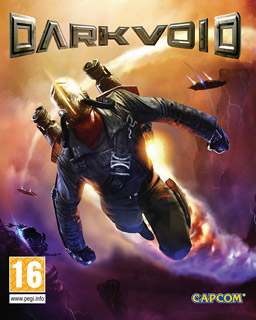
Game Review: Dark Void

We've been on the virtual front lines enough in the last few years to know what makes a good shooter and what makes a bad one, but it seems some developers are still struggling to figure it all out. Cue Capcom's latest failed experiment, Dark Void, a weird Gears Of War and Iron Man hybrid that somehow manages to do almost everything that's been done a thousand times totally wrong.

After being greeted by a half-dramatic title menu where a flying, steel Dark Void logo flies over what can only be described as a blue neon vagina, things kick off when pilot Will Grey (voiced by Nolan "One Voice For Every Hero" North) crashes his plane in the Bermuda Triangle, which turns out to be overrun by aliens called "The Watchers". Typical. Fortunately, Will stumbles across a gun and, hiding behind some conveniently placed rocks, gets to shooting.
The loading screens look gash

Unfortunately, the shooting is arguably the worst thing about Dark Void (apart from Nolan North, of course). Don't get me wrong, the cover and shoot gameplay works well enough (it would probably be more surprising if it didn't), but because of the weapons and AI it's incredibly dull. When the cover system works in games - Gears of War is the obvious example - it's because the enemy is smart enough to try and flank or expose you. There's none of that here; the enemy is quite happy sitting behind a column or tree trunk or park bench or whatever, popping in and out of cover until you've loaded it with bullets from one of your unimaginative weapons or smacked it around enough - which is basically done by hammering the melee button in the hope that you happen to initiate the attack quicker than the target, watching Will perform the attack from a slightly more cinematic angle (at which point you're unable to control him, so there's every chance that he could finish the attack only to find a grenade at your feet), then rinsing and repeating a few times until the alien falls over. Almost every ground-based shoot-out plays out this way, making the Dark Void experience utterly forgettable.
Wait, is that a flying Geth? Is there anything this game hasn't pinched?

This chug along in this manner for a while until Will meets up with a group of humans known simply as "The Survivors", who quickly hand him Dark Void's party piece: the jetpack. It starts of with fairly basic hovering - which is pretty nifty, and spices up the shoot-outs for a few minutes - but quickly becomes used for proper flight, allowing you to quickly take off from the ground and join in the dogfights. It could have been good but the jetpack doesn't handle particularly well. Standard flying is easy enough, but pulling off any kind of manoeuvre is a faff - you have to hold down one of the analogue sticks then flick both of them in a certain direction, which is way too much fuss when five UFOs are bearing down on your exhausts - and aiming is wild, making it almost impossible to target enemies and, consequently, making the dogfights more frustrating than fun.

Annoyingly, with the jetpack comes the introduction of a ridiculous amount of quick-time events. Pretty much anything that isn't simply hitting a Watcher in the face comes with a quick time event, and some of them are far to drawn out. Hijacking an enemy spaceship is the worst of them, because chances are you'll have to do that quite a lot what with the aiming is so bloody finicky. Normally quick time events have you press buttons in a certain order while something cinematic goes on in the background (see Uncharted 2/The Force Unleashed), which is fairly naff in itself, but hijacking in Dark Void is even worse. You don't press different buttons, you just hold down one and watch as Will pulls away at a sheet of metal. Pulls very, very slowly. You'll actually be sat there for a good thirty seconds, holding down one button while nothing really happens. Someone genuinely thought this was a good idea. You wouldn't even want them stacking the shelves at Gamestation.
Even at full boost, the pointlessly massive environments take far too much time to explore

As stand alone elements the combat and flight simulator are pretty poor, so it's no surprise that things don't get any better when they're combined. Dark Void's jetpack allows for a virtual cover system - let's say you're using the jetpack to climb a rock-face with a enemies at the top; you can use your jetpack to boost up the side of the cliff, grabbing on to protruding ledges and, while hanging from them, use them as cover as you make your way up. It's a novelty at first, but it still has all the problems that the regular horizontal gameplay does - except now you get a few particularly stupid enemies hiding on the wrong side of cover.


It's a shame really, as Dark Void should have been so much better. With the cover system shooting, the jetpack and the seamless transition between the two, it could have ended up as a decent game. But it's marred with poor gameplay decisions - namely the quick-time events - and lazy development, resulting in a drab, repetitive experience that you'll forget about five minutes after picking up a different game. To sum it all up: Dark Avoid.

...I'm sorry.

4/10

I'm sorry for the first caption as well...

Reviews Coming Soon:
Glee (Series review)
Being Human (Series review)
Mass Effect 2 (Game review)
MAG (Game review)

Tuesday, 26 January 2010

Game Review: Bayonetta

Coming from the same minds that founded the revolutionary Devil May Cry series, you’d expect the same stylish, brutal and blisteringly paced hack-and-slashing from Bayonetta that has made Capcom’s series so popular. What you probably weren’t anticipating were the slick slow-time mechanics, impossibly brutal finishing moves and perception-buggering visuals that make Bayonetta an early contender for action game of the year.

The gist of it (because any expansion on a gist would probably make both our heads hurt) is that Bayonetta is a witch, who spends her life killing angels to stop them dragging her down to hell. That’s all you need to know really. There’s a never-realised romantic sub-plot in there somewhere and something vague happened 500 years ago which apparently explains everything, but all that generally takes a back seat to inverse smiting. Which is fine, because that’s bloody good fun.

Bayonetta’s combat is, like most good games, easy to grasp but harder to master. It’s simple really; X shoots, Y punches, B kicks, and you string these together for damaging combos. It’s highly accessible; anybody could pick up a pad and immediately start beating the hell (heaven?) out of a few angels, and look fairly stylish while they’re at it. But then there’s that extra level of depth for more hardcore hack-and-slashers: last-minute dodges that slow down time, obscenely brutal torture attacks and a wide variety of weapons (including trombones and a snake whip) that can make Bayonetta a diverse, blisteringly paced and beautifully stylish experience that – at least until God Of War 3 comes out later this year – is unparalleled on the current generation.
Something tells me that the developers are having a bit of a dry spell.

As usual with this sort of game, there are regular boss fights throughout Bayonetta. They’re suitably challenging without completely spiking the difficulty curve, which is great, but more importantly they’re some of the weirdest bosses ever conceived. I mean, the first one is a giant, flying upside-down cherub face with dragons for ears. How could you not have fun killing that? After each boss you’re treated to a visually stunning “Climax” (did I mention the shameless sexual overtones? Only the Japanese), where Bayonetta’s hair (seriously) passes through the dimensions and becomes all kinds of giant creatures, fists, or whatever to finish off the enemy. Sure, it doesn’t really make any sense, but it’s so visually satisfying you probably won’t care. The only slight downside is that you will end up fighting the same bosses a few times, although these appear as toned-down versions to gradually raise the difficulty curve before tougher bosses later in the game, so their cameos are forgiveable.
Yes, that is a giant gargoyle face with a massive tongue tipped with a smiling, crowned cherub. Yes, it does have massive tentacles. I'll have one of what Hideki Kamiya is having, please.


Just in case there was any chance that the combat could become tedious (yeah right) Bayonetta spices things up the with a couple of phenomenally fast, arcade-y vehicle sections, which put you on the back of motorbikes and, er, a missile, as well as a mini-game between missions where you shoot enemies for extra points. These sections really help mix up the gameplay, making Bayonetta a surprisingly diverse and a constantly fun experience that is impossible to get bored of during the first playthrough.

The gameplay will probably draw all the expected comparisons; Devil May Cry, God of War, Ninja Gaiden and the like. But it’s the environments the separates Bayonetta from these games, giving the combat and platforming an entire new dimension that relentlessly buggers your perception – think Mario Galaxy, but with a super-powered receptionist in spandex. Running along walls to escape a lava flow, following a winding path that ends up with you standing up-side down, a hundred feet in the air facing the ground where you were just fighting, and jumping across giant chasms onto a revolving island are just a couple of examples of how Bayonetta plays with the dimensions, and it’s this completely different perspective that raises it above other games of its type.
And now she's running up a wall, dodging falling rocks while killing various flying things. There isn't much they haven't thought of, is there?

So Bayonetta, while making absolutely no sense whatsoever, is an absolutely superb game, raising the bar for all games of its type with its awesome, fluid combat and stunning worlds, and is probably as close to perfect as these games have ever come, experimenting with concepts and making them work so well with proven excellent gameplay. And with the ending leaving things open for a sequel, hopefully it’ll be around again in a few years as another incredible example of the hack-and-slash sub-genre. Frankly, it’s a must-rent for anyone who has ever enjoyed a hack-and-slasher. Chances are it’ll blow you away.

10/10

If you're still not convinced, the game ends with you kicking God across the solar system into the sun, then shooting up it's charred corpse. Best. Ending. Ever.

Reviews coming soon:
Glee (Series Review)
Being Human (Series Review)
Dark Void
Mass Effect 2

Friday, 18 December 2009

Film Review: Avatar

So this is it, then. Over a decade in the making, the film that would change cinema as we know it is finally here. Or maybe self-proclaimed “king of the world” James Cameron has just spent fifteen years and hundreds of millions of dollars setting us up for the biggest, preachiest let down of the year. Yeah, that sounds more like it.

Don’t get me wrong, I’m not saying Avatar is a bad film. The concept behind it – humans controlling synthetic beings, or Avatars, with their mind – is fairly ingenious, the setting is suitably epic and the technology used to create what is undoubtedly the best looking CGI so far may well change how future blockbusters are produced. But despite all this, Avatar still manages to fall short of expectations.

This is partly down to the plot, which Liege Cameron insisted would win over initial scepticism, being so contrived. It’s that old future-humanity-has-exhausted-Earth’s-resources- so-is-invading-a-peaceful-planet-and-warring-with-the-indigeanous-populace chestnut (a climate change message so glaringly obvious it’d make the audience blind if it wasn’t for the funky 3D sunglasses), with a few sympathetic humans taking up the natives’ banner. Sympathetic human du jour is Jake Sully (Sam Worthington), a paraplegic former marine who is drafted into the Avatar programme, and under the instruction of chief meat-head Colonel Quaritch is sent to spy on the local Na’vi – a species of giant, blue cat-people that look vaguely like Angelina Jolie after she’s been smacked around with a frying pan. But it’s not long before he falls in love with the Na’vi princess, Neytiri (Zoe Saldana), and the planet itself, causing him to turn on his own people and their reckless, greed-driven destruction of the planet (we get it Jim, global warming is bad). Essentially, Avatar is one Na’vi rendition of "Colours of the Wind" away from being Pocahontas in Space, which isn’t about to win over the thousands of keyboard-mashing sceptics that were Cameron’s target audience.

Neither will the characters, who are ironically two-dimensional considering Avatar is supposedly the benchmark for 3D cinema. It’s not that any of the supporting characters are particularly bad, they’re just never properly fleshed out, probably because there’s so much time spent on wide-frame panning shots of the planet’s undergrowth, which makes it a little difficult to muster up any sympathy when they start dropping like flies in the climactic final battle. Maybe they just wanted to get the boring human characters out of the way so they could introduce a greedy, six legged racoon in the sequel.

Still, the story of Avatar was never really the selling point, even if Tzar Cameron has convinced himself it is. It was the promise of the incredible new technology, which never fails to impress. As much as the endless shots of the planet’s environment detract from the story and its characters, they don’t half look good. Making this alien world and its creatures look entirely natural is a colossal achievement in itself. It’s safe to say that, if this is the future of CGI, then the future does look pretty damn awesome.

The 3D, however, still leaves a little to be desired, due largely to the restriction of cinema screens. The beautiful fluttering of insects or falling leaves is often cut short as it goes beyond the limits of the multiplex screen, and there was even a moment where the barrel of a gun poking into the audience was lopped off, probably poking out of the ceiling somewhere. Times like these make 3D look genuinely poor, and no arrow-flying-out-of-the-screen gimmick is going to compensate for that.

It goes without saying that Shah Cameron’s gajillion dollar masterpiece doesn’t live up to expectations. It’s an incredible visual achievement, one that may well go down in cinema history, but there’s precious little else to it. It might be worth seeing, if only for a glimpse of what blockbusters will look like for the next decade or so, but as a story it’s nothing you wouldn’t get from playing "Just Around the River Bend" over a Halo 3 cutscene while someone behind you shouts Lion-O quotes every five minutes. THUNDER CATS HO.

Saturday, 28 November 2009

Film Review: TTS: New Moon

The latest in the deservedly popular Twilight Saga, New Moon, is a masterpiece of film-making, a near-perfect story of tumultuous young love that is brimming with sparkling special effects, incredible performances that exceed the young cast's fame, and subtle yet evocative symbolism, the likes of which we have not been treated to since Shakespeare's Romeo and Juliet. At least that's how most of the teenage girl population will see it, anyway. Anyone else unfortunate enough to be swept up by the phenomenal hype that has surrounded the latest entry in the Twilight Series' (I refuse to seriously call it “Saga” as that is synonymous with “Epic”) will likely be underwhelmed.

New Moon picks up where the first Twilight film left off with Bella and Edward (Kristen Stewart and Robert Pattinson, as if you didn't already know) enjoying their respective lives and after-lives as the high school's awkward couple. It's all going relatively well, considering Edward's overpowering desire to eat her, until Bella gets a paper cut in a room full of blood-starved vampires. The youngest, Jasper, goes mental, lunging for Bella like a rabid dog that's just caught the whiff of a Pepperami, forcing Edward to leap to the rescue. Which he does in the most chivalrous of ways: by pushing Jasper into a piano and throwing Bella several feet into a wall. I can see how he makes girls swoon.

The experience sees a guilty Edward leave town, insisting he never belonged with Bella. Naturally, Bella responds by curling up like an angsty foetus, screaming herself to sleep and sitting in a chair for absolutely ages before she falls into the ridiculously huge arms of Jacob Black (he's a werewolf, by the way). And so the love triangle is born.

Then stuff just seems to stop happening. Oh sure, there are bits where Bella goes a bit suicidal or where Jacob goes all furry and eats that one black vampire from the last film, but it all feels like irrelevant filler between Edward leaving and Bella chasing him. Without Bella and Edward being together there isn't any point in the story because their love is the story; which I'm sure is something the writers are thrilled they managed to get across, but with Edward absent for most of the film that's a good hour and a bit where New Moon just drags on and on, with nothing really interesting really happening besides Jacob Black getting his kit off for no obvious reason. Not that many people in the cinema were complaining, mind.

But the big problem with New Moon isn't that nothing relevant happens for most of the film. It's Bella Swan, probably one of the most infuriatingly weak lead characters in the history of... pretty much everything. There's absolutely nothing endearing about her whatsoever - she's not funny, she's so absorbed in her own angst that she seems totally uncaring unless it's for something that will probably eat her, and she's got an annoying habit of screaming at the top of her lungs when said flesh-eating man beast isn't there to hold her hand. It doesn't help that Kristen Stewart is as utterly talentless as she is, failing to deliver even a half convincing line for the entire 130 minutes.

The love interests aren't much better. Taylor Lautner as Jacob Black stumbles through his lines like he's been caught in a foothold trap, while Robert Pattinson's undead dreamboat Edward Cullen is as bland as ever, although to be fair it's difficult to determine whether that's just the character or whether Pattinson is just a bit rubbish. At least if it's the latter his new forced moniker is appropriate. R Patzzzzzzzzzz.

Fortunately, New Moon’s supporting cast are every bit as good as the leads are bland and wrapped up in their own self-loathing. Ashley Greene is quirky and cheeky as the pint-sized Alice Cullen, ranking as the only likable character who doesn’t want to kill Bella. Then the slightly less friendly Volturi, an order of more conventional vampires led by the wonderfully camp and evil mind of Aro (Michael Sheen), steal the film in during their brief appearance.

While the Volturi may steal the show, they aren’t around long enough to save it. New Moon is a tedious, bland and altogether irrelevant chapter in the series that lacks any real focus until the dying moments. No question about this: avoid. It’s not worth the time or money regardless of how into the series you are. Just skip this one altogether and catch up on the awkward romance next year.

One plus for director Chris Weitz though: New Moon is probably little better than the Golden Compass was. Although saying that is kind of like handing Gillian McKeith a freshly-filled tuppaware tub and pointing out that it’s floating a little bit more than the last one you gave her.

Friday, 23 October 2009

What [person with nothing better to do in the mornings] watched last night

You know that little article next to TV listings in newspapers titled “What [bloke with incredibly easy job] saw last night”? I figured I'd start doing that since blogging about my everyday life was hardly stimulating writing, never mind reading. And tonight seems like as good a time as any to start.

Like most of the people who will probably end up reading this, it was that much-controversial episode of Question Time, which featured BNP leader Nick Griffin as one of the panelists, that was on the box last night. Although it seemed less of an intellectual, topical Q+A and more of a session in medieval stocks for Griffin, complete with peasants throwing rancid vegetables and calling him names.

I should probably get one thing straight before I continue; I don't like Nick Griffin, as a man or as a politician. I'm not defending him, his personal views or those of his party. I'm not saying I wouldn't enjoy watching him get a good verbal kicking in most other circumstances. But when it's coming from someone whose idea of wit is starting a sentence with “Dick, oh I'm sorry Nick” or a smug 12-year-old looking student with a blatantly massive stiffy for himself, it all gets a little tedious.

Besides the audience's juvenile insults and throwaway, self-satisfying lefty remarks making for rubbish television, isn't this is the sort of thing that has given the BNP a real hard-on in the past? No doubt they'll be using words like “injustice” and “undemocratic” to describe the audience's playground treatment of Griffin and they wouldn't be entirely unjustified in doing so. We may have given a far-right party with a history of racism a sympathy vote in exchange for a nob gag and a couple of smarmy comments. Superb.

That's not to say last night's Question Time was all bad. There were some good points made regarding the BNP's immigration policy (bricking up the UK-bound half on the channel tunnel and constructing a machine-gun nest on every beach) and Griffin's position on the panel - sitting to the right of a black woman - made unintentionally hilarious use of his lazy left eye as he seemingly kept a wary watch over her just in case she was concealing a tribal spear in her bandana. But other than that it was mostly forgettable; topics that should have been discussed – the BNP's current policies and the reasons for their recent rise to prominence – were largely ignored or were persistently dodged as panelists belted out years-old quotes to score easy points with the audience. In the end, the whole thing was utterly pointless.

Thursday, 1 October 2009

Game Review: Halo 3: ODST

Apparently the fight isn't quite finished yet.

Originally intended as a small expansion for Halo 3, Halo 3: ODST seemed to have become so much more. It became a stand-alone game, midnight launches and release parties were announced, and they even surprised us with a brilliant live-action trailer. You'd have been forgiven for thinking all this hype was leading up to a potential game of the year, instead of an expansion with a few tweaks.

The obvious change is that Master Chief, the series' mascot, isn't the focal character. Instead you assume the role of an ODST (which stands for Orbital Drop Shock Trooper, something I'm ashamed to admit I knew before ODST was announced), who are slightly more tactical than the gravelly, seven-foot colossus. With the change in personnel comes a snazzy new HUD - referred to in the game as a VISR, that comes complete with a map, list of objectives and not-quite-night-vision – and health system, with both the recharging shield and a health bar. Both have been integrated fairly well, and help make for a more tactical shooter than Halo 3. A couple of new weapons have been included too: a scoped pistol to effectively deal with Grunts and a scoped SMG that is...a little superfluous, really.
The new character: Rookie. A nameless, faceless, armour clad space marine. So not new at all then, really.

Supposedly, the ODSTs aren't quite as capable as the Chief, and this has been reflected in some of the gameplay tweaks; you can't dual-wield weapons, you can't jump as high, and you can't turn a tank into scrap metal with a few well-aimed punches. But at the same time you can rip a turret from it's stand and knock out a Brute Chieftain with one deft smack. Clearly they (Bungie) have tried to make you feel like less of a super-soldier, but haven't quite pulled it off. Whether or not that's a bad thing is debatable; some fans might be disappointed at the lack of change, others won't because it doesn't detract one iota from the experience.

Campaign is the initial draw of Halo, although in ODST it's a little insubstantial, lasting maybe five or six hours, with most of that time will be spent wandering the streets of New Mombassa (the city that was invaded during Halo 2), in a darkened sandbox environment with little-to-no visibility. This was a nice idea but, while credit is due to Bungie again for experimenting with a long established formula, it's an experiment that doesn't really work. The environment itself isn't particularly interesting to explore; every street looks identical, and enemies are few and far between. The lack of visibility, while suitably atmospheric, makes it so that even if there was something vaguely interesting to see, you'd probably miss it anyway unless you were permanently squinting. Even the use of O'Donnel's beautifully composed score doesn't work in the sandbox; it's fine for wandering around but once you find a couple of enemies it's slow, depressing melody feels incredibly out-of-place in a fire fight. Unless you're a dedicated achievement hunter you probably won't want to spend much time exploring New Mombassa, as there's no real purpose to it besides bridging the gap between the more enjoyable missions.

These other missions offer a stark contrast to the drudgery of the New Mombassa streets. The environments are bright and diverse, ranging from wide open nature reserves to teetering crates high above the clouds, that not only make brilliant use of O'Donnel's score but really show off the newly polished engine. Enemies are never in short supply, allowing for the fast paced action we have always associated with Halo. There is a slight feeling of familiarity; for example the second mission, which has you careering through a nature reserve in a Warthog, feels very similar to the Halo 3 mission "Road To Voi". But they're no less enjoyable, some ranking up there with the better missions in the trilogy.
The views are no less spectacular than they were in Halo 3.

The campaign, then, is a mixed bag, alternating between some of the better missions of the series and the probably worst executed idea in it to date. But the multiplayer has always been Halo's main appeal - even after two years, Halo 3 still regularly attracts gamers in their hundreds of thousands – and ODST contributes to that with a whole new co-operative mode: Firefight.

In Firefight, up to four players work to kill oncoming waves of enemies that become stronger and more numerous as the game progresses; anyone who has played either Gears of War 2's Horde or Call of Duty: World at War's Nazi Zombie modes will feel right at home. It's a good mode with a nice variety of maps and, for the most part (a little more ammo would be nice), well thought out. Halo fans will undoubtedly be coming back for more time and time again, like they have been doing with both Halo 2 and Halo 3's multiplayer for the past five years. On the other hand, for everyone else who maybe dipped into Halo before moving onto something else, it probably won't have that lasting appeal.

That's a potential underlying problem with Halo 3: ODST; it's the definition of fan service. For Halo fans it's great, they'll all get their moneys worth by replaying the campaign for achievements, by getting together on Firefight every other night, and feeding their addiction to Halo 3's multiplayer with the three new maps. But if you're not a die-hard Halo fan you'll most likely be left wanting because, although ODST is decent, there's not enough to it, even with the ever-so-slight price cut.

Tuesday, 22 September 2009

Game Review: Wolfenstein

It's been an eight year wait but the Wolfenstein series, one of the grand-daddies of first-person shooters, has finally made it's way into this generation. Known simply as Wolfenstein, can the latest instalment in the veteran series re-establish itself in an increasingly huge market of first-person shooters?

Things don't start off promising as we find the protagonist, B.J Blazkowicz (I wish I was kidding), disguised on board a Nazi U-boat off the coast of jolly old Blighty. However, it's not long (maybe ten seconds into the cutscene) before our all-American hero abandons all subtlety and, after a daring attempted escape, finds himself cornered by the crew. But, just as they're about to fire, a mysterious blue light emanates around B.J, shielding him from an onslaught of bullets before disintegrating his surrounding enemies. When his bosses realise that the strange light came from a medallion linked to Isenstadt, a German town that has recently become occupied by Nazi cultists, B.J is sent undercover to investigate the goings-on, and then put a stop to it.

As you can tell based on that opening cutscene (a lot of which should have been playable, instead of leaving you sat there completely bewildered for about five minutes), Wolfenstein boasts one of the most hilariously contrived plots in video game history. There are some brilliantly bad moments dotted around the cutscenes - like a heavily accented Russian man with a Stalin 'tasche and an eye-patch standing in a pub full of snarling Nazis warning B.J not to "blow our cover", or how everyone in Isenstadt seems to know the apparently undercover protagonist by his full name - that come around without even the slightest hint of irony. It's so horrifically, shamefully bad that it's almost good. Except it isn't really. It's just rubbish.

It doesn't get much better while you're playing Wolfenstein. Most of the single player is spent wandering around Isenstadt, a sort of psuedo-free-roaming environment that pretends to encourage exploration (loading screens will be full of "Search every corner of Isenstadt for gold and intel") but punishes you for doing so by respawning enemies every time you walk round a corner. By the time you've fought your way through, picked up the minimal gold that was lying around and gotten to the market to spend it, you'd need to spend about a quarter of it on ammo for your weapons anyway! Still, maybe this is a blessing in disguise, since the weapon upgrades are mostly useless (more on that in a minute) and the story isn't nearly interesting enough to make any intel worth reading. That, and exploring Isenstadt is probably the most depressing thing in the world. Every street being a dreary mixture of grey and brown, and with Wolfenstein's graphics looking so dated it's probably one of the ugliest games that's been released for a while.

The missions are a little better, since unlike the areas in Isenstadt they have some purpose and direction. It goes without saying that they're a little generic - this series helped define generic back in the 90's - but they're well paced, and grant you access to all kinds of new powers and equipment.

There's a good variety of weapons to choose from in Wolfenstein. As well as the obligatory weapons that appear in every WW2 themed game (MP40, Panzerschrek, etc) there are a couple of fancy, futuristic weapons, such as the particle cannon. Mixing these very different weapons together works very well; not so much because it adds variety, but because storming round an underground Nazi fortress firing a huge disintegrating beam into anyone that so much as mutters "Achtung" is a hell of a lot of fun. At least until you run out of ammo. The only irritating thing about the weapons was swapping between them, since with a PS3 controller you're never quite sure how much pressure to apply to the R2 button, so a lot of the time it either doesn't swap at all or it brings up the full weapon menu instead of instantly swapping between two weapons, which can be a real pain in the middle of a fire fight.

You'll also have powers, accessed through the aforementioned medallion. The three main powers allow you to control time, deal extra damage and create a personal shield, and can be used to quickly get you out of any tough situations you find yourself in. The other, more basic power, which lets you see the world through an alternate dimension (I honest to God cannot believe I'm writing some of this stuff with my tongue out of my cheek), showing you any secret passages, enemy weak points, and areas where you can recharge your medallion. It's a decent extra but most of the time it's fairly pointless. You'll use it but only because it's there, not because it ever feels particularly necessary to overcome difficult obstacles.

The same can be said for the upgrades system. As I said earlier, you can spend any gold you find lying around on upgrades for your weapons and powers, although in my experience with Wolfenstein it turned out to be pretty frivolous. Since the bigger weapons and later powers are so expensive to upgrade, I just ended up ploughing all my money into the sniper rifle and time control power, and coasted through the game near enough effortlessly with just that one weapon and power, and didn't feel the need to use the otherwise awesome futuristic weapons.

So then, Wolfenstein is ugly, contrived, dated, stupid, clunky, rarely challenging, and the protagonist is named after fellatio. In short, pretty damn bad. It's not as if there are no saving graces - I'm going to bring up that particle gun again - but they don't do much to make up for everything that Wolfenstein does so clumsily. Still, it's not without purpose. Maybe, in twenty years time, developers looking to bring back Halo or Bioshock will look at Wolfenstein and go "Actually, no". Unless they're spearheaded by Activision, of course.

Tuesday, 15 September 2009

Acorah to inspire Ghost re-envisioning.

Medium Derek Acorah is all set to inspire a remake of hit 1990 movie ghost, following the death of original star Patrick Swayze yesterday.

Acorah, who made a name for himself as a medium working alongside shrieking blonde Yvette Fielding on Living TV's Most Haunted, has stated his interest in recreating the classic romantic flick, which starred Patrick Swayze as a ghost alongside co-star Demi Moore.

“I've already heard from my spirit guide that Swayze's spirit has returned to his home, so we've already got one big name on location” claimed the veteran bullshitter. “If we could just drag Demi from canoodling her adopted son for a couple of minutes we'd be mostly set”.

Acorah did note that a problem with filming scenes with Swayze could be visibility. “It is true that most ghosts are ethereal, making them very difficult to spot for most people” he confessed, “but if you really visualise the ghost, you'll see it. Think of it like the Emperor's new clothes, but I'm honestly not pulling a fast one.”

“If test audiences still struggle, we'll get one of the guys to put in a floating dot that hovers around Demi's erect nipples, or something like that.”

Reports in Hollywood claim that Fox are already in the advanced stages of negotiating a film deal with Acorah and his spirit guide.

Saturday, 12 September 2009

Morning all.

Since someone's alarm went off at seven-bloody-AM on a Saturday, I figured I'd quickly write something up while the beast is still asleep next door.

I ended up getting Wolfenstein, and hopefully I'll have a review done for that by the end of next week. First impressions are that it's, well, poor. Really, really poor. I'd elaborate, but then I'd risk accidentally using a metaphor that I'd have rather used in the full review and then kicking myself for a good thirty minutes trying to thing of a new one. Just be safe in the knowledge that it features Nazis, occult artifacts and a huge chinned protagonist. See, now I don't even need to elaborate.

In other news, apparently it was the Dreamcast's tenth birthday the other day, which is nice. Having never owned a Dreamcast or even played one, I'm not exactly mourning it's short lived existence, but some of the write ups and interviews about it's downfall are fairly interesting, if not a little sensationalist and bum-licking. They're worth checking out, if you've got a few minutes going spare.

Anyway, I'm off to make a bacon sandwich so that when I do wake the missus, she'll have something to bit other than my head...off. That didn't work quite as well as I wanted it to.

Wednesday, 9 September 2009

I've decided that it's about time I got back into the routine I had started...wait, this sounds familiar.

You've probably noticed that I've not been doing much around here recently, apart from the odd review going up every couple of months before I crawled back into my proverbial hole. There are a couple of good reasons for this, or at least I'd like to pretend they're good reasons. My girlfriend has moved in (more on that at a later date), I've been on holiday, and somehow I've ended up with three dogs; officially qualifying me and anyone who enters my house as a weird dog person. So naturally I didn't have as much time on my hands as I used to back when I was churning out two reviews a week.

But, now that everything has settled down a bit, I've got a little bit more time and I should be able to get properly stuck into writing again. Unfortunately, since I'm saving up to move out, it's not going to be a case of two game or film reviews a week since I just don't think I can afford it at the moment. I'll be looking into more free stuff – regular blogging, TV reviews, satirical news and such like – just so that I can keep getting practice in. Not sure how interesting I'll be able to make blogging, mind - the most interesting thing that has happened to me in the last couple of days was when I rearranged all the pins on the notice boards at work into a hexagon, so I could find out what I'd look like to a golden spider who'd lost his glasses (as it turns out, gold and blurry) – but maybe I could throw a couple of cock jokes in there and make it all worthwhile.

Anyway! Plans for reviews this month are pretty straightforward. I'm renting two games today, one of them will be Motorstorm: Pacific Rift for my swanky new Playstation 3 (now you know why I can afford two reviews a week), and the other will be either Wolfenstein or Batman: Arkham Asylum, depending on what they've got in stock. Following that there should be a review of the Red Faction: Guerilla DLC, and then (predictably) Halo 3: ODST. I might even try and squeeze District 9 in there somewhere as well, even if I have to go on my lonesome.

You can expect an update round here every two or three days now, so if you're interested (or, more likely, seriously bored) you should keep checking up on this place.

See you around!

Tuesday, 8 September 2009

Game Review: Shadow Complex

It's not often that an Xbox Live Arcade title grabs the gaming world's attention in the same way that Shadow Complex has. Not only has it broken records on the Live Arcade for most downloads in an opening week, but it's been picking up critical acclaim from just about every major games site there is. Frankly, if that hasn't convinced you yet, then why you're reading the opinion of a no-name amateur with sub-par grammar is beyond me - especially since I'm probably just going to end up echoing everything they've said anyway.

Shadow Complex begins with Jason Flemming (voiced by Nolan North, who seems to be an obligatory inclusion in pretty much any video game these days) and his girlfriend Claire spontaneously exploring some caverns while on a backpacking trip, when they accidentally stumble upon a huge underground military complex. When Claire is captured, Jason is forced to put his convenient military training to use in order to infiltrate the base and rescue her. It has all the outline of a generic action plot but the characters - both the reluctantly patriotic Jason and the increasingly ambiguous Claire - and a sharp, witty script help make Shadow Complex that little bit more interesting than the standard video game story.
It's not long before every-man Jason has mastered the all-American hero strut

Gameplay is a little bit different, too. It's based on classic side-scrolling shooters (Super Metroid, Castlevania and the like), but the environment is 3D. So, while you can only move in two dimensions, enemies can appear anywhere in a level. It's an interesting twist on a classic concept that Shadow Complex pulls off almost perfectly - aiming can be a little frustrating sometimes, but the auto-aim compensates for that most of the time - and having this fresh challenge is something that anyone who tries this game will surely appreciate.
Failing guns, there's always the opportunity to just kick people in the face

Something else you're bound to appreciate is just how good Shadow Complex looks. Graphics are superb and Shadow Complex could easily itself off as an early full-price 360 game, but the real surprise is how varied the environments are. Inside the huge underground complex there are caves, warehouses, bright white corridors from the Tantive IV and underground lakes and rivers, which makes exploring and even backtracking through the complex really engaging, as well as allowing for loads of different situations.

To get you through these increasingly tough situations is a selection of guns - you'll start off finding a simple pistol and end up brandishing a giant shotgun of the future - and some incredibly cool gadgets, which you'll start picking up fairly early on in the game. Starting with the jetpack, you'll gradually come across scuba gear, grappling hooks and - probably best of all - speed boots that let you smash the speed barrier and run up walls. The constant access to new items mean that, as well as giving you the excuse to go back through the map and solve old puzzles with your new found skills, combat is constantly given new dimensions; why take cover behind a box when you can thrust yourself into the air and shoot a live grenade in their mouth? Most importantly, however, is the simple torch that you start with. Aside from being used to illuminate dark caves and vents, it also shows hidden areas and how to access them - for example, if a vent cover glows orange then you can shoot your way through - which can result in all kinds of rewards if you're patient enough to pour over the entire complex.
Why yes, he is running on water. Why are you still reading?

The only niggling issue with Shadow Complex (besides the aiming) is the fairly rubbish bosses, all of which have a suitably impressive introduction that is match by their complete ineptness to create the kind of challenge that a boss fight should. Either they're entirely predictable - just find the incredibly obvious weak spot and spam grenades until it blows up - or it's just ridiculously easy. There are even some bosses that can be killed while they're off screen, just by back-pedalling until they're out of sight and then shooting in their general direction. Maybe it's because we're so used to games like this, or maybe it's because I'm soft and was only playing it on normal difficulty, but they just seemed far too easy and obvious. Still, this is just a niggling issue, and when the rest of Shadow Complex is as brilliant as it is you really shouldn't be put off by it.

All things considered, Shadow Complex is definitely worth your time. Fast paced, great looking and full of cool gadgets, for only 1200 Microsoft points you're getting one of the best games that's been released so far this year on the 360. See, told you I'd be saying the same as everyone else.

Friday, 14 August 2009

Film Review: G.I.: Joe: The Rise of Cobra

Now that Hollywood is running out of comic book characters for it's summer action blockbusters it's time for toys to take their place on the big screen, and following Transformer's box office success toy giants Hasbro have decided to give G.I.: Joe it's cinema debut in The Rise of Cobra. But with an all star cast including someone from an Amanda Bynes film, that pretty girl from the new Hugo Boss adverts and Marlon Wayans (I know, my heart sank when I found out he was in films as well), it wasn't looking particularly promising.

Things start off in 1641 - it just wouldn't be a proper toy franchise film without a hastily explained and completely irrelevant back story now, would it? - as the lead villain's great-great-great-great-granddad Klan McCullen is punished for selling weapons to both sides of a war. Then time accelerates a few hundred years to the near future where the nefarious James McCullen (Christopher Eccleston, the only face you'll recognise during the film which isn't just a five second cameo) is developing weapons of his own, while simultaneously planning to take over the world. As you do.

These weapons end up in the hands of the incredibly responsible US Military, led by All-American hero Duke (who is unintentionally referred to as "Dook" throughout the film, which is mildly hilarious) and his allegedly comic relief sidekick Ripcord. It's not long before they're ambushed by McCullen's Cobra soldiers, led by Sienna Miller in skin-tight black leather (I can hear you booking the tickets already), who try to steal the weapons back (which just makes you wonder why they sold the weapons in the first place) and it's not long before they're ambushed by G.I.: Joe (who isn't just one G.I called Joe, but a whole bunch of people collectively known as "Joes". I'm confused too). After the Joes have routed Cobra with their superior CGI they whisk Dook and Ripcord to their super secret base where they're recruited into the elite team.

That's about twenty minutes of the film and you can probably guess where it goes from there - Cobra get weapons again, shit hits fan, Joes save day, Dook gets girl, credits roll, The End - but since this is an action blockbuster based on an action figure it's probably a bit harsh to slate it for being predictable. But it isn't too harsh to slate it for all the pointless back story it ham-handedly tries to weave in inbetween all the CGI explosions and black leather. Having one back story - like the one explaining Doctor Who's motivation for world domination - is forgiveable, but there's one for every other character. As if we need an explanation for why the black ninja doesn't like the white ninja. They're different colours, we just fucking accept it.

There is a bunch of other stuff wrong with G.I.: Joe but it's not as if I need to spell it out for you, just think of pretty much anything that could be wrong with an action blockbuster and the chances are that it'll be wrong with G.I.: Joe. But there's always the slightest hint that everything it does is a little tongue-in-cheek, as if director Stephen Sommers knew that turning G.I.: Joe into a decent action flick was next to impossible so decided to screw it up completely for poops and giggles, giving G.I.:Joe a distinct Team America feel. It even goes as far as to replicate the opening scene, where the good guys inadvertently destroy most of Paris before bewilderedly questioning why everyone is so annoyed at them. It's a shame they couldn't include the sing-a-long about AIDs, though.

I suppose how much you enjoy G.I.: Joe: The Rise of Cobra will depend on how you watch it. As a stock action film it's mildly entertaining, and as a completely piss-take it's slightly genius. Just don't try watching it from a discerning, critical perspective because then, obviously, it's absolute rubbish. But people with discerning, critical perspectives shouldn't watch films like G.I.: Joe anyway.


...


AND NOW YOU KNOW


AND KNOWING IS HALF THE BATTLE

GEEEEE AAAAAAYEEEEEE JOOOOOOOOOOOE

Monday, 3 August 2009

TV Review: You Have Been Watching

Charlie Brooker, the cynical and seemingly sociopathic mind behind BBC4's excellent Screenwipe, has gone all mainstream in his latest television foray on, er, television with new Channel 4 quiz show 'You Have Been Watching' - where Brooker quizzes three guests on recent weeks television to test their knowledge, creativity and punch lines. Half way into the series' eight week run, how is Brooker coping under the heat of the studio lights?

You Have Been Watching seemed to have a winning formula. Brooker quizzing various comedians (and, for some bizarre yet obligatory reason, Jamelia) were amusing enough, while his own Screenwipe-esque segments were still as funny as they were when it was just him sitting alone in a darkened room (even if there were fewer words bleeped out). But for some reason, which has become increasingly obvious as the series has dragged on, this doesn't quite seem to work.

One reasons for this could be the guests, who all seem a little mismatched. Obviously the inclusion of Jamelia in the opening episode was a little odd, but even the likes of Frankie Boyle and Reece Shearsmith - people with the kind of dark humour that you'd think would match up well with the likes of Brooker - somehow feel out of place and awkward with each other and the host, almost as if they're worried about being too funny in case they accidentally upstage Brooker and he bites off their heads in retaliation. Which is a completely unfounded fear, as his neck isn't nearly long enough to reach the far end of the set.

But the main problem seems to be Brooker himself who has become increasingly awkward with both the audience and the guests as the series has gone on, and seems unable to develop any kind of rapport with either. This was most obvious during the third episode; while Brooker jokingly berated the three guests they sat gawping in confusion, like school students being yelled at by a new substitute teacher, with the whole thing followed by hesitant applause from an audience who were clearly so dumbfounded by the speech they'd forgotten to read the big red "applause" sign dangling from the studio rafters. Maybe that's the point, maybe Brooker - a man who who often referred to himself as misanthropic - is maintaining an awkward atmosphere as a private joke between him and the producers. It's just a shame nobody else gets to laugh.

That said, You Have Been Watching is still good for a few laughs, just not quite as many as you'd have expected after watching the likes of Screen and Newswipe. What made those shows funny is still there, it just lacks the harsh, brash language that made them both so much more entertaining. As for his newly chosen format, so far it's unconvincing. The guests and flashy set just get in the way of what everyone actually wants to see; Brooker sitting alone in a darkened room vocalising his hatred and making jokes about bums. Maybe I'll dig out a couple of old Screenwipe episodes tomorrow night instead.

You Have Been Watching is on at 10pm, Tuesdays nights on Channel 4.

Saturday, 1 August 2009

Game Review: Transformers: Revenge of the Fallen

The video game adaptation of Transformers: Revenge of the Fallen never really looked like it was going to be any good. Never mind the fact that it's a movie tie-in, but the developer and publisher history - practically non-existent and shamelessly corporate respectively - didn't exactly fill anyone with optimism. Still, so long as it sticks to the premise of giant robots transforming into sports cars and planes and kicking the crap out of each other it can't be all bad, right?

The good news is that Revenge of the Fallen does just that. In both single and multiplayer you'll play as either Autobots or Decepticons, and roam around small areas of Japan, America, Egypt and wherever else scrapping with other giant robots. With a decent sized arsenal of weapons and vehicles, there's enough here to keep the novelty fresh for a good couple of hours. Although once that novelty wears off, it all starts going rapidly downhill.

The first thing you'll notice is the controls, which are all over the place. The developers have tried to find a system that allows you to quickly transform between the three modes - weapons, vehicles and movement (allowing you to scale buildings as your chosen Transformer) - but in doing so have come up with an overly complicated and fiddly system. Let's say your driving down the road in vehicle mode (so holding down the right trigger), and you see an enemy on top of a building. If you want to take a shot at them you have to let go of the right trigger to exit vehicle mode, hold down the left trigger to go into weapons mode, turn around to target the enemy, choose which weapon you want to use with the left or right bumpers, and then fire on them with the right trigger. How complicated is that? Considering the d-pad isn't being used for anything and would be a much simpler way of switching between them, developers Luxoflux have made what could have been a simple system needlessly intricate and irritating to grasp.

While Revenge of the Fallen does stick to the giant mechanical brawl idea instead of dithering about with awkward teenage romance (I know you're probably not reading this Mr Bay, but take notes if you are), in the single player it will become very tedious, very quickly. The option to choose between playing as Decepticons or Autobots is appreciated, but ultimately unnecessary since you'll be playing through exactly the same levels and the enemies you fight - a selection of identical mini Autobots and Decepticons depending on which faction you choose - aren't varied or challenging, so fighting them throughout the few hours of each campaign is incredibly repetitive. Annoyingly, Luxoflux could have easily prevented this by giving the Decepticons human enemies rather than the rubbish mini Autobots, which could have done wonders to spice things up a bit - I mean, who wouldn't want to wander around as a mechanical behemoth blowing up armies of oncoming tanks? - but naturally, they've gone for the cheaper, easier option. With this being an Activision published movie tie-in it's hardly surprising, but you can't help but feel a little disappointed when you think of how much more potential there could be in a Transformers game.

It doesn't help that the repetitive missions are accompanied by equally repetitive voice-overs. After completing a mission, the chosen faction will sit around a giant holographic globe monotonously discussing your mission performance. Who actually thought it'd be a good idea to have five badly voice-acted robots blather on for however long about accuracy statistics and uncompleted bonus objectives? And who decided to make it unskippable? And who tested without pointing out how bloody stupid it was? And who... fuck it. There are too many individuals to blame. I'll just Google the address of Luxoflux's development studios and bare my arse in that general direction. That'll show 'em.

The closest Revenge of the Fallen comes to have a saving grace is it's multiplayer, but even that is riddled with faults. There are only four game types and there's very little map variety, and players have an irritating habit of dropping in and out of games so multiplayer lacks any consistent pace. When enough people do stick around matches can be competitive and fun, but this happens so rarely that it's not often worth sticking around for. Like everything else with Revenge of the Fallen then, Luxoflux have put the bare minimum effort into the multiplayer and it really shows.

So Revenge of the Fallen is, unsurprisingly, one of the worst games to have come out for the 360 this summer. It's completely half arsed, and Luxoflux don't seem to have put any effort in anywhere. It's a shame really, after playing through Wolverine: Origins it seemed there was a glimmer of hope for movie tie-in titles, but that view has been well and truly jaded after playing through this thoroughly average excuse for a game. And to think the same people who published this are genuinely threatening to up the price of their games to £55. Where do they get the knackers?

Monday, 13 July 2009

Ethnic minorities excluded "'cause a Brother can't swim"

Following the media hysteria around the exclusion of a young group of racial minorities from a swimming club, the President has made a statement defending the club's actions.

John Duesler Jr, President of the Valley Club, had earlier this week excluded a group of African American and Hispanic youngsters from using the club's swimming pool, claiming that the children would "change the complexion" of the club, and today spoke out defending his statements.

Duesler, who appeared in front of reporters wearing a large sun hat and with his nose doused in sun screen, said that "Our motivation for excluding that group of children is not racial, we have to maintain a respectable image as a swimming club. And that is not one that we can maintain with black children."

"I mean, if someone from a rival swimming club came round and saw a group of black kids flopping around in the pool - 'cause we all know they can't swim - what would they think of us? We're just trying to protect our own reputation."

One of the pool's lifeguards was outspoken in his agreement with Duesler: "I've never had to perform so many rescues in that pool in a day. It's not like I could tell the difference between them either, so I could hardly stop them jumping in again afterwards."

In the meantime, the excluded Creative Steps Inc. have reportedly been offered the use of another club's athletics track. Executive Director of the day camp, Alethea Wright, said "it's good to see that not everyone is as closed minded as the Valley Club is acting at the moment, and there are those out there who don't adhere to outdated racial stereotypes."

Saturday, 11 July 2009

Game Review: Prototype

With several years of hype behind it, it's unsurprising that Prototype was one of this summer's most anticipated releases. It promised so much, boasting free-roaming environments, flowing parkour and highly destructive superpowers in the months leading up to it's release. But has it managed to live up to it's own hype, or is this another ambitious but ultimately disappointing gaming blockbuster?

After kicking off with a brief, teasing sample of the chaos and devastation to come, Prototype rewinds a fortnight and we see the man who was just walking around with swords for hands wake up on a morgue table and realise he's somehow developed superpowers. This man - Alex Mercer - quickly finds himself being forced to uncover a conspiracy to try and discover who he is and exactly what has happened to him. Naturally he does this by walking around New York City eating people who he thinks might be slightly relevant. It's not nearly as complex or interesting as the thousands of random and irrelevant plot elements would have you believe, but it's a good enough staging ground to show off one of the coolest mix of powers there has been in a game for a long time.

Alex starts off with the basic powers, which include enhanced strength, speed, durability and agility. While they're never going to be as efficient as the shape-shifting powers you'll unlock as you play through Prototype, these abilities allow you to traverse New York City however you please and, whether that's pelting down the middle of the road at a hundred miles an hour, leaping between skyscrapers or just climbing to the top of the Empire State building and hopping off into the carnage below, you'll experience a freedom of movement that is unrivalled on the 360 and which will never become tedious.

The other basic ability Alex possesses is shape-shifting, allowing him to blend in with the crowd by taking on a different form such as a pedestrian or a soldier by consuming them. While shape-shifting can be useful early on it gradually becomes obsolete, since as you progress enemies that can detect you through a disguise start appearing more often, meaning that previously stealth-based objectives such as infiltrating an enemy base become mad consume-and-dash missions. It's a decent feature, and tricking gullible marines into killing one of their own is always a good laugh, but it's never going to vary the gameplay like it could have done.
Consuming someone for their appearance is a simple process of grabbing them and eating their face off.

As you play through the story and completely the various side missions, you'll have the chance to unlock and upgrade other powers, most of which revolve around Alex's shape-shifting abilities. However, these powers aren't about blending in with the crowd: they're about literally blending the crowd. Just a few of the powers you'll include giant hammer fists, giant claws and even a long whip (where Radical Entertainment missed a glorious comedic opportunity by attaching it to his arm and not somewhere more provocative) to deal with the hordes of zombies, soldiers, and innocent screaming pedestrians that litter the street. These distinctive abilities allow you to play Prototype however you want, and keep the already slick and hilariously gory combat fresh and varied throughout the game.
And I thought the cheestrings in the adverts were a bit mental.

If the wide selection of highly destructive powers doesn't quite cut it for you, Prototype is more than willing to throw in some more highly destructive toys for you to play with including machine guns, tanks and helicopters, all of which are remarkably easy to use. Using a weapon is a simple case of aiming and shooting - although the fiddly auto aim can be a pain since it doesn't understand that adjacent giant infected monsters are greater threats than a woman flailing her arms half a block away - while tanks and helicopters handle very smoothly, and it won't be long before you've completely mastered the controls for both and are taking them on wild rampages through Central Park. So, unlike other games where vehicles and weapons feel a little tacked on and unnecessary, Prototype has integrated them perfectly, and adds further diversity and chaos to it's already dynamic, varied and totally manic experience.

With the sheer amount of mayhem on screen, you'd imagine Prototype would be constantly suffering frame rate issues, texture pops and other irritating technical issues. But amazingly, it doesn't. Everything runs very smoothly throughout - at least it doesn't if you've taken the five minutes to install it onto your 360's hard drive. The downside to this is that Prototype isn't the prettiest game - the environment is a selection of dull greys and browns, the textures would have looked poor in a later last generation game, and the limited amount of character models are ugly and bland. Then again, if you're stood still long enough to notice any of this stuff then you're not playing the game properly, and should really get back to mindlessly slaughtering people with giant hammer fists and rocket launchers - because while the looks may be flawed, the utter carnage of combat is near enough flawless.
I know it's supposed to look disturbing, but does anyone else think the beastie on the left's expression looks remarkably like the Awesome face?

That said, there are a couple of niggling issues with Prototype. The camera, while fine when leaping over skyscrapers or single handedly re-enacting the running of the bulls in a street full of zombies, isn't particularly good in closer environments, where you'll often find your view obstructed by a piece of debris or a wall. The side missions can be fairly repetitive as well, but since you can dip in and out of them as and when they're hardly a game killer.

Minor flaws aside, Prototype is a mind-blowingly fun experience, and delivers on more than enough of it's ambitious promises to make it worth your while. If you've ever played a game where you sliced something's limb off and your only thought was "Holy shit that's cool", this is something you should definitely pick up. Like, right now. Meanwhile, if you're looking for something a little more complex and involving then Prototype probably isn't it, but frankly if you're going to turn your nose up at the awesome, bloody mayhem because Prototype doesn't have the sophistication or depth of other games then you're a pretentious cock and I don't like you.